
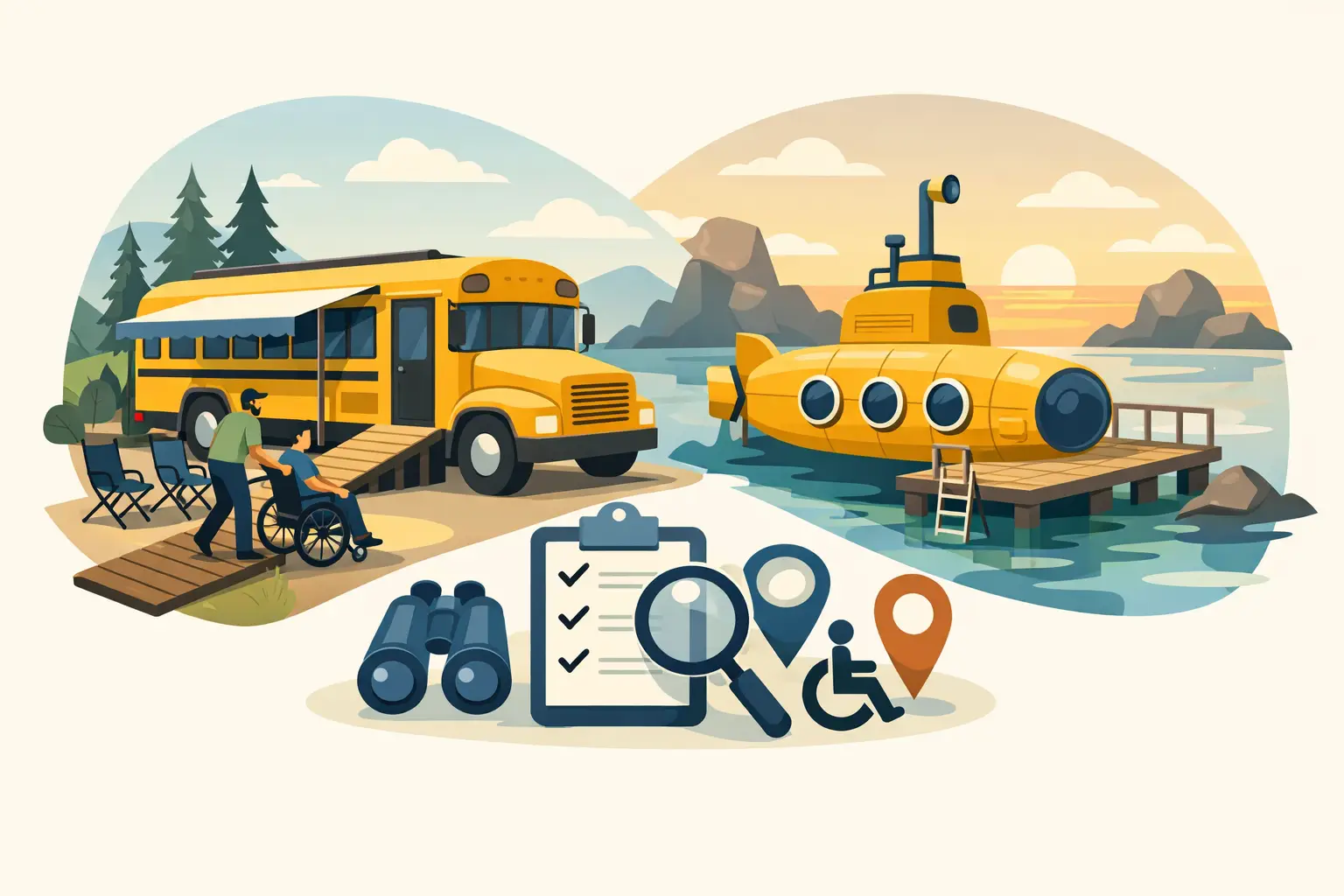
A countryside break should not begin with a game of guess-the-gravel-path. If you are asking, is glamping accessible?, the honest answer is: it can be, but the word “glamping” on its own tells you very little.
A bell tent with fairy lights may be wonderful for one guest and wildly impractical for another. A converted bus can deliver serious comfort and bags of character, yet its steps, doorways and layout may matter far more than its yellow paint job. Accessibility is not one neat tick-box. It is about whether a particular place works for a particular person, family or group.
The good news is that a little clear information before you book can turn uncertainty into a properly brilliant escape. Here is what to look for – and what to ask – before packing the snacks, wellies and emergency supply of marshmallows.
Is glamping accessible for everyone?
Not automatically. Glamping sites come in all shapes, sizes and levels of practicality, from level-access cabins with nearby parking to hillside tents reached over uneven ground. “Luxury” can mean a king-size bed and a wood-fired hot tub, but it does not necessarily mean step-free entry, adapted bathrooms or wide internal turning space.
Accessibility can also mean different things to different guests. A wheelchair user may need firm, level routes and accessible washing facilities. Someone with limited mobility might be comfortable with a couple of well-supported steps but need parking close by and a proper mattress. Families travelling with a buggy, a guest recovering from surgery, or grandparents who do not fancy a midnight trek to the loo have equally sensible questions.
Then there are invisible access needs. Some guests need clear arrival information, predictable layouts, quiet spaces, allergy-aware cleaning, low-sensory options or flexibility around assistance dogs. A great host will welcome specific questions rather than offering a vague “you should be fine”.
Start with the journey from car to bed
The most useful accessibility detail is often the least glamorous: what happens between arriving at the site and getting inside your accommodation?
Ask where you can park and how far it is to the unit. Check whether the route is grass, gravel, mud, paving, decking or a mixture of the lot. A photo taken in bright summer weather may look perfectly easy, while the same route after a Devon downpour can become a different beast entirely.
Find out whether the ground is level, whether there are slopes, and whether paths are wide enough for a wheelchair or mobility aid. If there are gates, ask how they open. If you are travelling with children, consider whether the walk is manageable with bags, sleeping children and the inevitable mountain of holiday paraphernalia.
It is also worth asking about lighting. Campsites are meant to feel tucked away from the everyday, which is part of the magic. But low lighting, uneven terrain and a late-night dash back from the communal facilities are not everybody’s idea of a relaxing adventure.
Steps, ramps and entrance widths
Quirky accommodation often has quirks in the practical sense too. Converted vehicles, shepherd’s huts and raised pods may have steps at the entrance. Ask how many there are, whether they have handrails, and whether a ramp is available or suitable.
Door width matters, as does the space just inside the entrance. A place may be reachable but still difficult to use if the doorway is narrow or the furniture leaves little room to manoeuvre. If you use a wheelchair, walker or transfer equipment, share the measurements you need. It may feel detailed, but it is far better than discovering a holiday hiccup after you arrive.
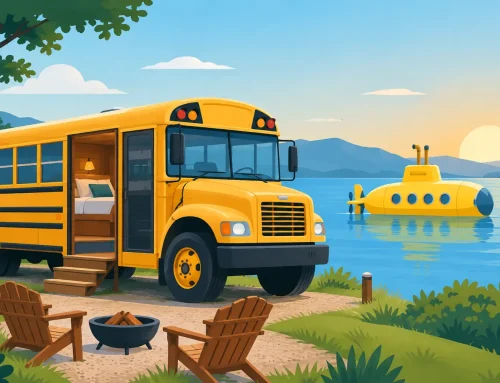
At American School Bus Glamping, the accommodation is part of the adventure – gloriously offbeat, story-filled and rather more exciting than staring at the same beige caravan walls. That character is exactly why guests should check individual unit details carefully, particularly where bus steps, compact spaces and campsite terrain are concerned.
Do not treat bathrooms as an afterthought
Bathroom arrangements can make or break a stay. Some glamping accommodation has an en-suite shower room; others use shared campsite facilities. Neither is automatically better, but each comes with questions worth asking.
For an en-suite, check whether the bathroom is on the same level as the sleeping area, whether there is a step into the shower, and whether there are grab rails, a shower seat or enough space to turn. A stylish roll-top bath may look lovely in photos, but it may not be the easiest option for everyone.
For shared facilities, ask how far away they are, the route to reach them and whether an accessible toilet or shower is available. Ask whether the accessible facility is kept unlocked, how it is accessed, and whether it is exclusively for accessible use. If you need a hoist, adult changing bench or other specialist equipment, do not assume it will be there unless it has been explicitly confirmed.
There is no prize for being low-maintenance. Your comfort is the point of the break.
Think about the inside, not just the entrance
Glamping interiors are often cosy by design. Cosy can mean delightfully snug for a couple, or a bit of a logistical puzzle if somebody needs extra floor space. Ask for an honest description of the layout, including bed height, access around the bed, seating, kitchen arrangements and any internal level changes.
Bed height is particularly useful to know. A low futon-style bed might be perfect for some guests and a nightmare for someone who struggles to stand from a low position. Bunk beds may suit enthusiastic children but are not ideal for everybody, especially if a guest cannot safely use a ladder.
Kitchen facilities deserve a quick check too. If self-catering is part of your plan, ask whether worktops, sinks and appliances can be used from a seated position. If not, consider whether your group can share those tasks comfortably. A few simple adaptations and a good travelling companion can make a huge difference, but only when everyone knows the set-up beforehand.
Accessibility is also about energy, senses and confidence
A holiday does not have to involve a visible disability to need thoughtful planning. Crowded communal spaces, unfamiliar noises, bright outdoor lighting and a change in routine can be draining for autistic guests, people with anxiety, those with sensory sensitivities and families travelling with neurodivergent children.
Before booking, ask how busy the site is likely to be, where the accommodation sits in relation to shared areas, and whether there are quiet periods or quieter pitches. Request clear check-in instructions and practical photographs of the route, entrance and facilities. Knowing what to expect can take the edge off a new environment.
If you have allergies, ask about bedding, cleaning products, pet policies and cooking arrangements. If an assistance dog is travelling with you, discuss this before booking so the host can explain the site rules and make appropriate arrangements. Specific needs are not awkward requests. They are the information that helps a host give you a decent answer.
The questions that get useful answers
Rather than asking only, “Is it accessible?”, explain what you need and ask direct questions. For example: “Can you confirm the distance from parking to the accommodation, the surface underfoot and the number of steps?” Or: “Could you send recent photos of the shower entrance and the route to the toilet block?”
If you are travelling in a group, think about the whole stay. Can everyone join in around the fire pit? Is there seating with backs and arms? Is the hot tub reached by steps? Are there safe places to charge mobility equipment? Does mobile signal work if you need to contact someone? Tiny details can be the difference between merely managing and actually relaxing.
It also helps to ask what happens if the weather turns. British countryside breaks are glorious, but they are not famous for their stubbornly dry forecast. Firm ground, covered communal areas and a straightforward route to facilities matter much more after rain.
A good accessible glamping break feels easy, not heroic
The right glamping stay should leave room for the fun bits: board games on the table, muddy boots by the door, a proper laugh with your favourite people and a story that begins, “Remember when we slept in that bus?” It should not require anyone to battle steep paths, unsuitable bathrooms or surprise stairs just to get through the evening.
So, is glamping accessible? It absolutely can be when the accommodation, site and support match your needs. Be gloriously specific, ask for real-world details, and choose the place that gives your group the best chance of switching off and making memories – with the only serious decision being who gets the last toasted marshmallow.