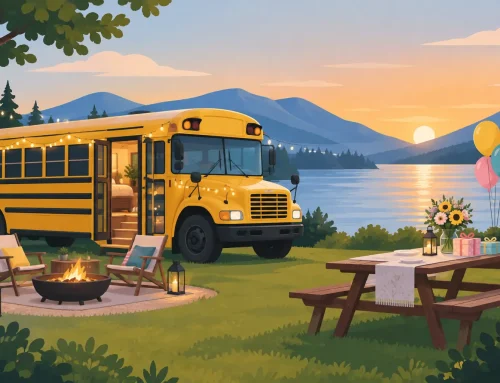


A converted school bus is not your average family holiday hideaway. There are bunks to claim, a driver’s cab to peer into and enough yellow, retro brilliance to make children forget their screens for five whole minutes. But are bus stays childproof? The honest answer is: they can be wonderfully family-friendly, but no unusual accommodation should be treated as automatically childproof.
A bus was originally built to move passengers, not to host a crawling toddler, an enthusiastic seven-year-old and a midnight trip to the loo. Once lovingly transformed into glamping accommodation, it can be comfortable, cosy and packed with character – but its layout still deserves the same sensible once-over you would give a cottage, cabin or campsite.
Are bus stays childproof? The straight answer
“Childproof” suggests that every possible hazard has been removed. For family travel, that is rarely realistic – and it is especially unhelpful language for a stay with steps, compact spaces, outdoor grounds and optional wellness facilities. A better question is whether the bus stay is suitable for your child’s age, confidence and needs, and whether you can supervise them comfortably.
Most families are not looking for a padded room with beige walls and nothing to climb. They want somewhere exciting that still feels manageable. A well-planned bus stay can absolutely deliver that: proper beds, a weatherproof place to sleep, a kitchen or food-prep area, heating, lighting and the glorious novelty of sleeping aboard something that looks ready to rumble off down Route 66.
The trade-off is that quirky spaces ask parents to stay switched on. The very features that make a converted bus memorable – raised entrances, ladder-style bunks, small corners and a cockpit-like front section – may need a few clear house rules.
Start with your child, not the bus
Age matters, but temperament matters just as much. A steady, safety-aware four-year-old may be perfectly happy with a short flight of steps, while a fearless ten-year-old who regards every railing as a climbing frame may need closer watching.
Babies and newly mobile toddlers are the group most likely to need extra planning. Before booking, consider where they will sleep, whether there is room for a travel cot, how you will manage steps and whether the furniture layout leaves tempting gaps or hard edges at head height. If your little one is in their grab-everything-and-run era, a conventional cottage with stair gates might be the easier choice for this particular break.
For primary-school children, the bus itself is usually part of the fun. Give them the safety briefing early: no climbing on furniture, no leaning out of windows, no solo expeditions around the site and no playing on steps. Say it with mock-serious bus-driver energy if required. “Tickets, please. Also, feet off the dashboard.”
Teenagers tend to love the independence and photo-worthy setting, but they still need boundaries around shared outdoor spaces, late-night wandering and amenities such as hot tubs or fire areas. A holiday is not a free pass to abandon common sense, sadly.
What to check before you book
Family-friendly does not mean every bus accommodation has the same layout or facilities. Converted vehicles are delightfully individual, which means the details really do matter. Read the accommodation description carefully, look at current photographs and ask direct questions if anything is unclear.
First, check the sleeping arrangement. Are the beds on the same level? Is there a top bunk or ladder? Are bed rails supplied, or would you need to bring portable protection if appropriate? A top bunk can be the crown jewel of a child’s holiday, but it is not suitable for every age or sleeper.
Then look at access. How many steps lead into the bus? Is there a handrail? What is the path like from parking to the accommodation, especially after rain? Somerset and Devon can serve up gorgeous countryside and properly squelchy mud in the same afternoon, so shoes with grip are not merely a fashion statement.
Think about the practical bits too. Check where the bathroom is located, whether children would need to cross outdoor space at night and how close the bus is to other guests, roads, ponds or livestock. Ask about heating, plug sockets, cooking equipment and where you can safely store medicines, cleaning products and snacks that might otherwise become a midnight feast.
It is also wise to ask whether the accommodation is designed for the number and ages in your party. A bus may sleep a particular number of guests, but a family of two adults and three small children has very different needs from five grown-up friends with matching festival jackets.
The features that need adult supervision
The bus itself is only one part of the stay. Campsite facilities and outdoor extras can be the absolute making of a family escape, but they are not hands-off entertainment.
Hot tubs, saunas and ice baths need particularly careful thought. Follow the site’s age guidance, keep an adult present and be realistic about whether your child can follow instructions around heat, water and slippery surfaces. An ice bath may be a cracking story for adults who fancy a wellness challenge. It is not a paddling pool with dramatic branding.
Fire pits, barbecues, wood burners and cooking equipment also call for clear boundaries. Decide where children can play while food is being prepared, keep handles and hot drinks out of reach, and do not let the excitement of al fresco marshmallows turn into a chaotic game of flaming sword fights.
Outside, check gates, fences and the distance to any water, animals or vehicle access. Even on a peaceful site, young children should not roam alone. The best campsites feel free and adventurous, but freedom works brilliantly when children know exactly where their grown-ups are.
A simple arrival routine makes a big difference
The first ten minutes after you arrive are when children are most likely to sprint about in a joy-fuelled frenzy. Before bags explode across the floor and someone claims the best bunk, do a quick family lap of the bus and its immediate surroundings.
Show everyone the entrance steps, explain which areas are out of bounds and point out the toilet route for after dark. Choose a place for torches, shoes and coats so no one trips over a welly mountain at bedtime. Put medication, sharp items and cleaning supplies somewhere high or secured, then decide where mobile phones and keys will live.
For younger children, it helps to make the rules short enough to remember: walking on the steps, no climbing, ask before going outside and find an adult before using special facilities. There is no need to suck the fun out of it. Frame it as becoming honorary bus crew.
Pack for comfort, not a full nursery conversion
You do not need to arrive with an industrial roll of bubble wrap. A few useful items can make a family bus break calmer without turning check-in into a logistics operation. Bring a night light if your child dislikes unfamiliar rooms, a torch for outdoor bathroom trips, slippers or grippy socks for indoor floors, and familiar bedtime comforts.
A small first-aid kit is sensible for any holiday. So are waterproofs, spare socks and layers. Bus stays are brilliantly cosy, but the adventure outside is still British countryside, where weather changes its mind more often than a toddler choosing a biscuit.
If your child needs a travel cot, bed rail, high chair or any particular accessibility support, confirm availability and dimensions before you set off. Never assume an unusual space will fit your usual kit in the usual way.
Why the quirks can be worth it
There is a difference between a stay that is merely safe enough and one that makes a family properly light up. A converted bus can do the latter. Children remember the moment they spot it, the arguments over bunks, rainy-card-game afternoons and the delicious silliness of telling their mates they slept on a school bus in the countryside.
At American School Bus Glamping, the whole point is to stay different and make the accommodation part of the story – not just the place everyone collapses after a day out. That sense of occasion is a huge win for families who are tired of holiday rentals that could be anywhere.
The sensible approach is not to ask whether a bus stay is magically risk-free. Ask whether its layout, facilities and setting suit your family right now. Check the details, supervise the exciting bits and give everyone a role in looking after their extraordinary little home on wheels. Then get on with the important business: making the sort of holiday memories that outlast the muddy trainers.